The Remedy
Dear Vera,
You are still a child, but not for long. You and I passed each other in this world. Like travelers on a trail, you nodded to me on your way out, just as I was arriving. But I know you from stories told by my mother and grandmother, and some of your stories have become my own. So, I know that life is coming for you. No one can ease it, but woman to woman, I can tell you what I see:
When you are nearly grown, you will marry a golden man. His name, actually, will be golden: Golden Bean. He will marvel at your quick wit and your cascade of soot-black hair. Together you will leave your pious town in its dry, salty valley, say goodbye to your mother and the many sisters of your youth and then travel north for days, deep into the forest. Up the wooded slopes of the Tetons to a logging camp. That place will smell of mud and smoke and sap. Everyone who lives there, even briefly, will be forever lacquered with its tawny residue. Your job will be to feed them – the men, that is. Men are forever hungry, and you will fill them up, day after day, again and again, so that they can do their work and ask you for more. You are accustomed to feeding your brothers and uncles. You know how this goes.
At night, while the wolves howl outside, you and Golden will share a small cabin with a resident spotted owl. In those frozen hours, on a cotton mattress hammered thin by other bodies, you will discover the rare and miraculous pleasure of newlyweds who are lucky enough to find that their bodies, like lock and key, are meant for each other. Afterwards, spent and surprised at yourselves, you will each pull your wool long-johns back on in a shy attempt to trap the warmth of hedonism inside. Then descend into an interlocking sleep while the owl watches over you.
Vera, you were raised in a house full of women, the braids and bosoms and rustling skirts always outnumbering the men they served. Many hands in each pot – in both collaboration and competition. But now, like Cleopatra herself, you will have your own harem. Two dozen men that look to you for sustenance and the favor of a smile.
Let yourself enjoy it, Vera. Let yourself watch them working the way that men have always watched women dancing. You will be queen of that kitchen, mistress of its life-giving stores and armed with its sharp utensils, should you need them.
Soon you will wonder which leaf it is that will stop you from retching behind the woodshed. Then, as your body grows, you will wish you had listened more closely to your grandmother when she taught your mother which roots will bring on the pains and which tree bark will ease them. So, you will have to ride out that first tempest alone in your cabin with only Golden’s eyes on you, saucer round with terror and adulation. Outside a crowd of men will hover, smoking, waiting through the night, listening to you howl back at the wolves. They will bring boiled water in pots from the fire like you instructed them, thinking of their faraway women and praying for your survival as though you were their own.
Afterwards, you will hold the tiny being against you while your blood and salty waters drip through the floorboards into the damp earth underneath. You and your babe will sleep for 3 days, waking only to feed and then return to a darkness inhabited by your sister’s voices. At your request, Golden will bury the iridescent afterbirth in the forest and wash the now-stained marriage quilt your sisters made for you. Then he’ll spread it on the cabin roof to dry in the brief rays of morning sun. So that it returns to you stiffened by smoke and chill and alpine sunlight.
On the fourth morning you will rise, shaky and remade; a different woman than the one that lay down on that bed. You’ll tie the baby between your taut and smarting breasts, flinching at the fabric against your newly enormous nipples which are already scabbing over like the crust on a pie. During the days of your metamorphosis, the men have tolerated a watery root soup inexpertly concocted by the blacksmith. They cheer and clap with relief and pride when you enter the kitchen and return to your post at the iron stove that oxen had dragged up the mountain.
The kitchen knives and the broom, the hatchet and ladle, they are still yours. Familiar and stained from the grip of your hand, but also foreign to you, as though they mean something different now; their angled shapes imbued with the possibility of violence. While you chop and knead and stir, your head bows every few moments to inhale the pure, yeasty scent of your child’s perfectly round head. It is somehow both fresh and earthen and induces cravings that no woman ever spoke out loud. When you are alone in the kitchen, you will extend your tongue and gently lick his salty scalp, tasting the delicious mineral flavor of his body, which perfectly mirrors the deficit in your own.
Within a week your nipples will become ripe blackberries, in both shape and color. Masticated from your child’s jaws, who is increasingly scrawny and shrieking with hunger. He is frustration embodied. Inside your blouse the heat of malady creeps upwards like a collar tightening. You will remember a remedy for your sister’s milk-clogged and infected breasts, so you wear cabbage leaves cupping you like Eve’s fig leaves and you stuff them with a poultice of chewed plantain to ease the pain.
But it is too late for this, and when you finally retreat to your bed you will sink into the rippled waters of a fever dream. The currents pulling you further and further from the anchor of your body and the distant cries of what must be someone else’s hungry baby. Unknown days and nights will pass like this – infection raging through you. In a rare lucid moment, you wake to the rise and fall of urgent voices; it is your harem of worried men huddled outside the cabin attempting, as men always do, to strategize their way out of mortality. Desperate and directionless, your body is now the target of both their fear and their chivalry.
The next time you wake, Golden’s pleading eyes are there, inches away, his voice flimsy, frantic and almost unrecognizable. He will grasp your face in his rough hands, tell you he loves you and he is sorry. Then he will beg you not to resist what’s about to happen.
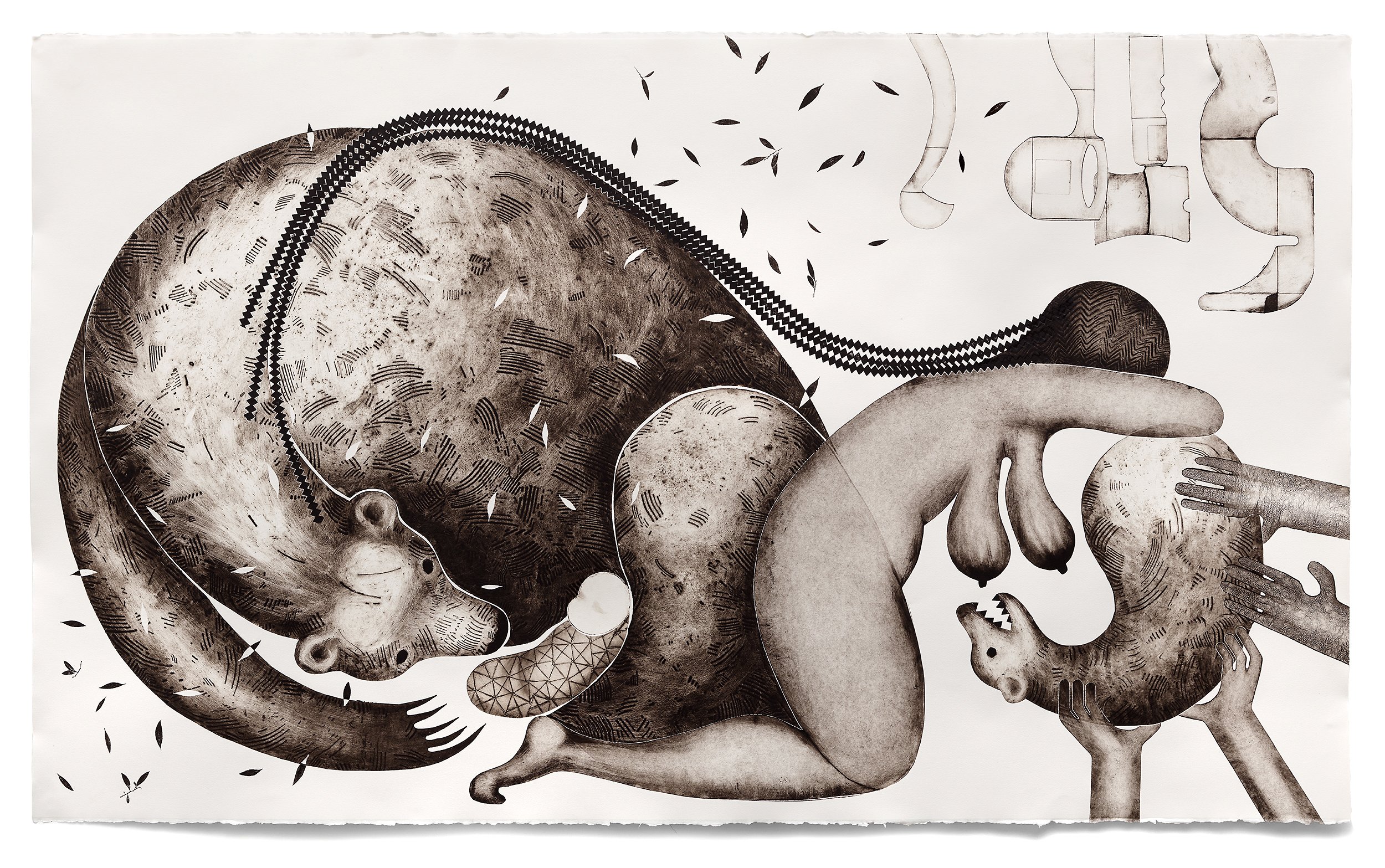
A storm of men bursts through the doorway, something dark and writhing held between them (a dog, perhaps?) with thick fur and flailing claws, but when they pull the burlap sack off its head you will see the terrified eyes of a baby bear. Like it, you begin to buck and someone grips your ankles to keep from being kicked. Many hands on you, young and old and leathery, stained and cracked with work, your modesty vacates you and you see yourself as Gulliver tied down by an army on all sides. They bring it close, onto the bed. The moment it smells you the tension in its body releases. It calms, then you do as well, exhausted from your brief struggle. Everyone is stone still as it snuffles up along your torso, following the same linea nigra that your child did, and roots beneath your sweaty breasts. No one breathes as it opens its mouth and takes hold.
First there is a cracking blaze of pain, but it is mercifully brief. In the hot wet of its great mouth you will feel a tugging and then the strange sensation of pulling like a tide that begins at your toes and moves upward, dredging even the marrow of your bones, sucking outward. You feel channels opening and debris breaking loose in the floodwaters. You will surrender to this tide and as you do the churning waters slow to a rhythmic, pulsing flow that engulfs you first in relief and then, to your surprise, love. Wide and expansive, with room not only for this animal pressed against you, but for the men with their gaping mouths and strong hands and the owl in flight somewhere and the creatures you cannot see, but you know are nearby. With your fingers embedded deep in its fur, you can feel the warmth and eagerness of its body and you might wonder if this is your child and, in your days of fevered absence, have you become a mother bear?
Outside, she watches from the edge of the clearing. Deciphering the interwoven scents of mammalian survival, scanning for traces of her cub. Near the fire, which has burned for days while the men sat vigil, a man is rocking the sleeping infant in a wicker basket. He rises and steps out of the circle of light, disappearing in the direction of the woodshed for more fuel. In that liminal moment she saunters her immense body into the glow, shaggy haunches caked with mud; her underside a habitat all its own. Each claw is as big as a raven’s beak. Her enormous head bows low to the basket, allowing her black nose to brush against the velvet orb of the infant’s still-soft skull. Her moist nostrils flare at the scent of this tiny, pure, unwritten animal whose otherworldly preciousness is evident even to a beast. She shudders slightly with recognition and moves on, in search of her cub.
You will wake to pinpricks of light coming through the stacked logs of the cabin wall and your own infant folded, quiet and warm, against you. In your body you will find a memory of fur and claws, of a crowd cheering or threatening – it’s unclear – and a forceful current, like a flash flood washing through you. And then the lingering warmth of love and expansion, as though your body now encompasses the entire camp and all its inhabitants. Even the forest is within you now.
When Golden enters the cabin, his face instantly reveals that this was not a dream. He tells you that they released the bear cub where they had caught it, in the same grove where he buried the afterbirth. You decide that once you are strong enough, you will go there to thank her, the mother.
Seven decades later you will hold me, your newborn great-great-grandchild, against your brittle, crescent body and breathe in the irresistible fragrance of the abyss that infants carry with them into this world. This smell is a thread that tethers generations, like beads strung on a necklace. You will tell this story to the new mother, ripe and raw from her own initiation. And then, two days later, with a wide swath of new April sunlight crossing your bed, you will exhale this and every other story that you hold, then quietly re-enter that abyss.
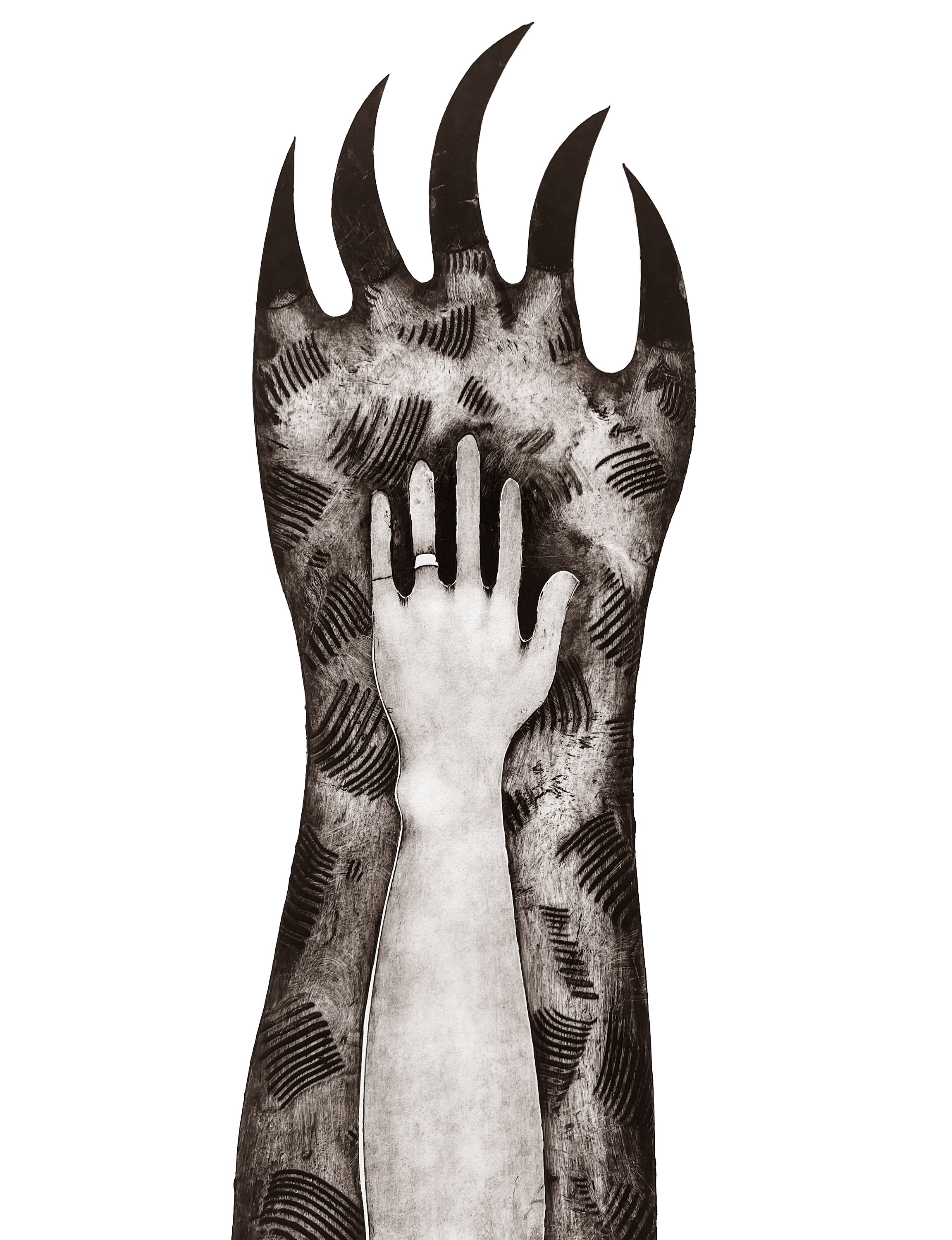
This story is based on the true-life events of my great-great-grandmother, Vera Bean, who was born in 1885 and lived in Mormon communities in Utah, Idaho and Southern California. It is illustrated by an installation of large shaped-plate intaglio prints made at KALA Art Center and University of Northern Iowa, 2024-2026. Art and writing by Klea McKenna www.kleamckenna.com